

Every conversation starts with a bold opinion, and then we put it to the test. Just candid conversations, different perspectives, and the occasional uncomfortable truth.
Jessica Phillips, Senior Marketing Director at Ironpaper, spends her days helping B2B companies turn marketing activity into something more intentional, connected, and useful to buyers.
Devin Aken, Marketing Director at Ironpaper, has worked alongside Jessica for nearly seven years. He approaches content with an emphasis on craft, structure, and the role each piece plays in helping buyers make decisions.
Jessica: We know your name and we know your title, but let's skip the standard business intro and get to know you a little differently. You were asked to bring a coffee mug or a drink that says a little something about you. What did you bring?
Devin: I've got this coffee mug from my hometown. It was made in the Roycroft Arts Studio, which is a nice little handmade studio in East Aurora, New York. It's a nice reminder of home every single day, and I think everything there is beautiful. So it's a reminder of commitment to craft every single day.
Jessica: Love that. How much coffee do you drink a day?
Devin: I usually try to stick to two cups. Sometimes I venture into three-cup territory, depending on the day. You know how they go.
Jessica: Yep. I feel that. Let's see where this one takes us today.

Jessica: Let's get a temperature check. Are you "on fire" — could not agree more; "a bit warm" — there's some truth there, but not totally bought in; or "ice cold" — not having it?

Devin: I would say absolutely "on fire." This is very much an issue right now, and we'll probably dive into why the creation of more low-value, untested, disconnected content is very much becoming a problem. I'm seeing more and more businesses come in with a lot of content. Some of it was created recently, with AI helping expedite things.
A major problem businesses are having right now is what content is worth creating, and then how to organize that content. But that initial take over the past year or so has really been around the volume of content and less about being intentional — where are we intercepting that buyer during their decision journey, what are the questions they're asking, and how do we make sure we have some sort of perspective, not just within an individual content piece, but in laying content tracks that ultimately help them gain value throughout that journey.
Jessica: That makes a lot of sense. You and I are in similar roles, so I know we've had our fair share of experience doing content audits for clients. Is that something you feel is a must-have at this point when you start working with a client, just to understand the lay of the land? And then, second to that, do you often find that they have a lot of content that really has no purpose?
Devin: Usually what we find is that quite a bit of content has been produced. One of the first steps we usually take with a new client is looking at what they've already created. How can we better containerize or group those assets together? And then, where are there gaps within that journey? Where are we starting? Where does it lead? We make sure everything is as connected as it can be. Obviously, these can lead to very complex systems, but we try to get at least loose journeys in place so we can track whether people are progressing through them.
Jessica: Think back to times you've had to have conversations with a client about this kind of revelation around their content inventory. How do they typically take that? Because it can be somewhat personal when you're trying to deliver a message like, "Hey, the work you've been doing is not as valuable as you think it is."
Devin: Those conversations have tended to take a level of stress off the clients I've spoken with. I can see shoulders relax, because even with the volume of content that has been created, there are opportunities to remix it. There are opportunities to find those containers throughout the site where that information can be grouped. SEO and AEO love structure, so creating that structure helps us get found more frequently.
Jessica: You've talked a few times about the buyer's journey in relation to content. Can you talk a little bit about how those two go together?
Devin: In B2B, our sales cycles — the time from lead to SQL — have gotten longer. SQL to opportunity has gotten longer. At the beginning of that journey, someone isn't looking for awareness; they're looking to investigate a core business challenge and measure the impact of that. Then they start putting options on the table that aren't vendor-specific: "Okay, what are the possible ways I can solve this problem, and is it worth my time solving this internally, or do I reach out to a vendor to potentially partner in that transformation?"
If I decide to go down that route, I've already read all of this great educational content that has given me a lot of confidence around this topic. I'd like to reach out to these two to three vendors, and this one was especially helpful throughout that journey, and I believe this company has the best possible solution.
Jessica: Is there a world, though, where more content could improve marketing? Say it was only in the awareness stage, and you were using AI to generate more educational or thought leadership content than you were able to beforehand. Could that work?
Devin: I think there is a world where you could create a lot of content in one stage, but creating content across multiple stages helps us create that connected system. If we were to focus on just one stage, we'd start to get into a bit of a difficult progression problem.
Jessica: No one asked me, but at the beginning of this conversation, I was definitely in agreement with you — I was "on fire." I've since started shifting more toward "warm," because now that we've talked it through, I'm thinking that if you were creating more content and paired it with a strong SEO and AEO strategy — content with intention, like you were saying — there could be value there. But you're right, you do have to carry it through with decision and consideration-level content, because at some point you want these folks to convert and become a lead for your business. And if you're only putting out a ton of awareness content with no strategy or intention behind it, then it's just content with no real purpose.
Devin: Which could be a fantastic giveaway, but at the end of the day, we need to see some sort of ROI from our work. So we need to make sure there are spaces along that journey to get content and capture leads. We can see that in our conversion rates, things like that. So, totally.
Jessica: In today's marketing landscape, everyone is looking for quick wins, that instant gratification, but content can really play such a long-game role in your marketing strategy. I think that's where it fits best in some scenarios, like the topic cluster conversation and things of that nature. It can become really powerful for your marketing engine if it's done right.
Devin: You might have some gold locked away in your current content inventory. You might just have to rediscover it and give it a little bit of a refresher. So, zhoosh.
Jessica: Definitely zhoosh. Love that word. Can't spell it.
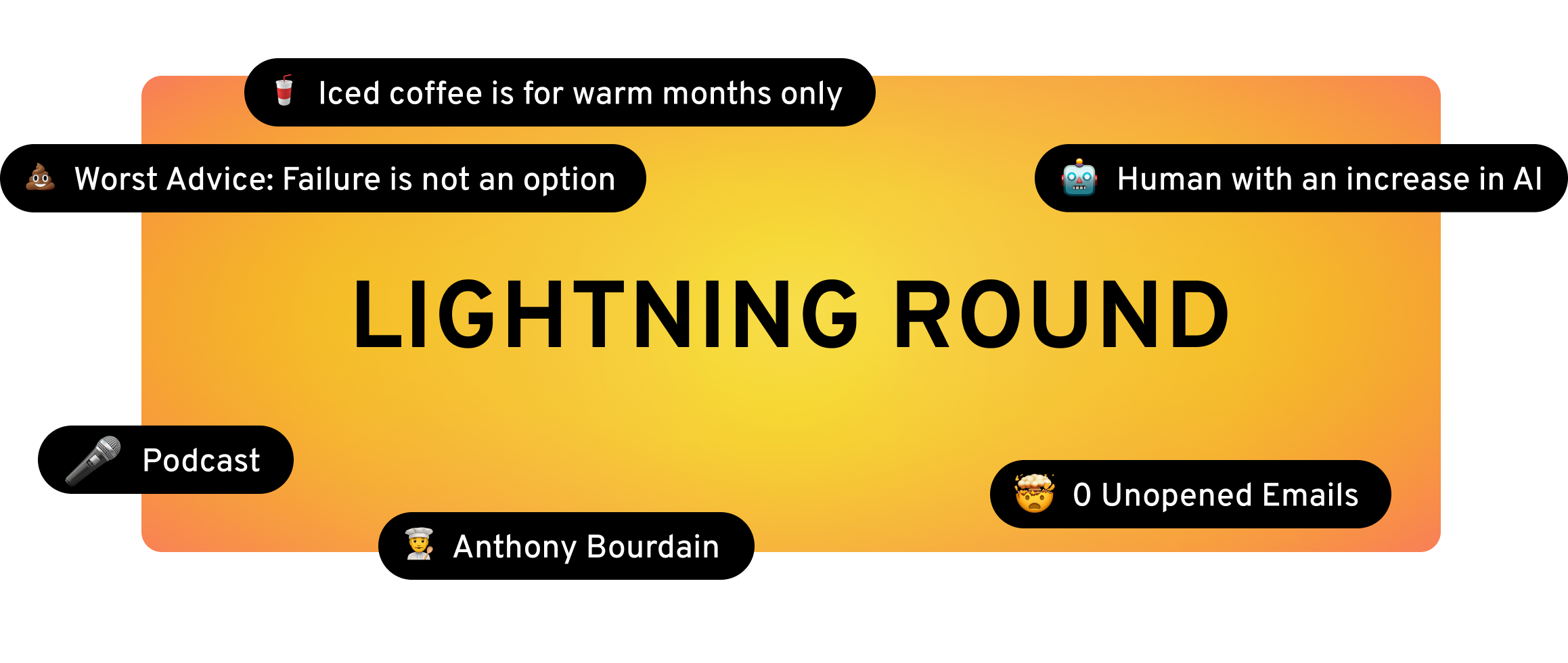
Jessica: Let's run through a lightning round. Just remember: short one-word, couple-word answers here. I just want to get to know you a little better. What is one marketing hill you'll die on?
Devin: Making content intentionally, and not just using AI to create a waterfall of irrelevant content.
Jessica: What's the worst piece of business advice you've ever been given
Devin: Some environments create an opportunity to fail selectively, and others make failure a "this cannot happen" game. Especially in marketing right now, there's a lot changing, and being able to be intentional, test, and then — when we fail, because not everything will work — being able to understand why.
Jessica: What is one word your team would use to describe your leadership style?
Devin: I'd probably say "open." I'm usually a fairly open person, and I like hearing a chorus of ideas.
Jessica: I would agree with that. I've worked with you for a while. What's one thing you wish people would stop doing tomorrow in a marketing lens?
Devin: Using the word "optimization." That word drives me nuts, and I hear it all the time, and I feel like it's one of those things that just doesn't have much value anymore.
Jessica: Definitely. Book, podcast, or person that has changed the way you think?
Devin: Probably a podcast. I love listening to those throughout the day. Whether it's history, education, philosophy, or design, I love getting a variety of perspectives from outside marketing. It would be hard to put just one, but I like seeing how lots of different creatives work and how we can pick that up for our own processes.
Jessica: If you could have coffee with anyone, living or dead, who are you picking?
Devin: Anthony Bourdain would probably be at the top of that list.
Jessica: Rapid fire. Slack or email?
Devin: Slack.
Jessica: How many unopened emails do you have right now?
Devin: Zero. I just opened the last one before this conversation.
Jessica: Biggest productivity hack?
Devin: The biggest productivity hack is a pretty simple one. This might be one of the best pieces of business advice, too: just writing down your to-do list every single morning on a sticky note helps you process what you have to get done that day.
Jessica: Isn't there something so nostalgic about actually writing it down, analog style? Do you write it, or do you type it?
Devin: I usually write it on a sticky note. My inbox is very clean; my desk and sticky notes, not. But it's helpful to see what I've accomplished throughout the week.
Jessica: Do you have a B2B prediction for the next five years?
Devin: I don't have one right now, and that's because things are changing so rapidly. I'd love to have a crystal ball and see what things will look like in five years, but right now things are changing so quickly. I'm just trying to keep an eye on the ground.
Jessica: You've survived the lightning round! But before I let you out of the hot seat, what is one hot take you genuinely believe but think maybe not everyone will agree with?
Jessica: Are you saying that you're judging people if they're drinking iced coffee in the winter?
Devin: Yes. In which case, I'm judging my twenty-year-old self walking with an iced coffee when it was thirty degrees outside.
Jessica: There is something to be said, though, for shaking that ice in that iced coffee right before you take a sip. It is so good.
Devin: Definitely agree. It's a hot take — or is it a cold take? 😂
Jessica: One of the things I hope people take away from these conversations is that there are very few easy answers in business. The best ideas hold up because we're willing to challenge them, not because everyone agrees with them.
by Jonathan Franchell, CEO of Ironpaper - For more tips and hacks: Need to remove a new line after h1 tags? Both web designers and SEO practitioners need to employ headline tags: H1, H2, H3 in several ways to improve web page structure and tag...

A fundamental shift is underway in how businesses discover, evaluate, and select their partners. The traditional B2B marketing model built around predictable funnels and quarterly campaigns is becoming less effective. Buyers no longer move neatly...
by Jonathan Franchell, CEO of Ironpaper - For more tips and hacks: For iOS app developers, there are some annoying parts of the development process that many developers just hate. For one, only one person can be nominated to be Team Agent on Apple's...
The Crowded Arena of the IT Marketplace Updated December 2024 The Information Technology (IT) landscape is experiencing rapid growth and intensifying competition. IT spending is projected to reach nearly 5.1 trillion U.S. dollars in 2024, a...