B2B Marketing
Updated: December 11, 2025
By: Regan Venezia
B2B Marketing in 2026: Discovery, Trust, and Human Context
A fundamental shift is underway in how businesses discover, evaluate, and select their partners.
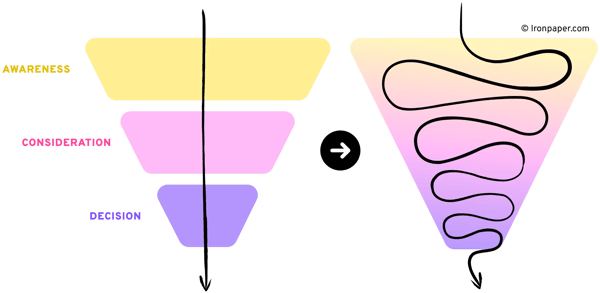
The traditional B2B marketing model built around predictable funnels and quarterly campaigns is becoming less effective. Buyers no longer move neatly from awareness to consideration to decision. They jump in and out of the process, often guided by peer insight, automated recommendations, or content discovered in unexpected places.
In 2026, discovery is no longer a moment. It’s an environment. Buyers are continually seeking ideas, expertise, and credible guidance. And that environment is increasingly shaped by two forces:
- Automation accelerates the process of how information surfaces.
- Trust determines what information actually influences decisions.
Technology can help buyers find you more quickly. However, credibility and relevance are what will keep them engaged.
The Decline of the Traditional Funnel
The marketing funnel once gave B2B organizations a sense of order. Awareness flowed to engagement, engagement to lead, lead to sale. However, that model breaks down when the buyer's journey no longer follows a linear path.
Today, buyers might:
- Research a solution anonymously for months.
- Revisit your brand after reading peer feedback.
- Be reintroduced through an AI-generated comparison or voice interface.
- Decide only after consulting colleagues who have prior experience with your company.
The process is cyclical and dynamic. Buyers enter and exit multiple times, blending human judgment with automated assistance. Funnels assume control. Discovery demands adaptability.
The New Buyer Discovery Model
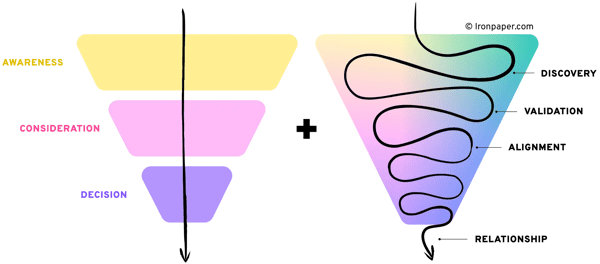
The emerging model of buyer discovery is built on four interconnected stages: Discovery → Validation → Alignment → Relationship.
- Discovery: The first interaction often occurs through AI-curated recommendations, peer networks, or content ecosystems, rather than paid ads. The priority is visibility through relevance, not volume.
- Validation: Once interest is sparked, buyers seek evidence such as data, expertise, or proof of results. Trust begins here.
- Alignment: Buyers assess the fit and consider strategic, cultural, and operational aspects. Shared values and clarity of approach now weigh as heavily as product capability.
- Relationship: The process doesn’t end at purchase. Buyers continue evaluating through delivery, communication, and shared learning.
Every touchpoint presents an opportunity to demonstrate expertise, transparency, and consistency in this model. The marketing process extends far beyond acquisition. It becomes a system of ongoing validation.
The Role of AI is Amplifier, Not Author
AI will shape how information is found, but it won’t decide what matters.
Algorithms can prioritize efficiency, but they can’t create meaning. They can summarize expertise, but not originate trust.
In 2026, the most effective marketing teams will utilize AI as an amplifier to analyze complex data, accelerate insight, and reveal new opportunities. Humans remain at the center of interpretation and decision-making.
For example:
- AI may identify which content themes attract high-value accounts, but humans decide which stories should be told and why.
- AI may predict which prospects are most ready to engage, but people build the narrative that earns their confidence.
Automation will handle scale. Judgment will handle significance.
Trust as the Primary Currency
In 2026, trust will overtake attention as the most valuable marketing currency.
The market is already saturated with automation. AI tools can generate endless outreach, content, and noise. Buyers are responding with selective attention. They reward credibility, not volume.
Trust is earned through clarity, transparency, and sustained expertise. It shows up in:
- Case stories that share lessons, not just results.
- Educational content that helps the buyer make sense of change.
- Honest communication about limitations, risks, and context.
Buyers are growing resistant to unverified claims. They want validation or proof that a company understands their environment and can act with integrity inside it.
The brands that invest in being helpful first and persuasive second will dominate the new discovery economy.
Designing for Continuous Discovery
Continuous discovery requires a shift from campaign thinking to system thinking.
Rather than treating marketing as a sequence of isolated launches, adaptive organizations build feedback loops that link insight, action, and measurement.
This means:
- Using first-party data to understand not just who converts, but why.
- Structuring marketing and sales alignment around shared intelligence, not separate metrics.
- Treating every piece of content as an experiment in message resonance.
- Measuring momentum like conversion improvement, engagement depth, and decision velocity rather than surface metrics like clicks or impressions.
Content, analytics, and operations should form a living feedback system. It should refine what’s published, tested, and shared.
The question shifts from “What’s our next campaign?” to “What are we learning about our buyers this month?”
The Human Advantage
Technology can scale communication, but it can’t replicate context. The differentiator in 2026 will be how well organizations understand nuance, how they read between data points, and interpret what buyers actually value.
Human intelligence drives connection. It explains why two identical offers perform differently depending on tone, empathy, or credibility. It’s the difference between visibility and relevance.
In an era where AI generates abundance, the scarcity is insight. The marketing leaders who cultivate curiosity, critical thinking, and authentic communication will outperform those who only automate processes.
A Trust-First Future
The future of B2B marketing won’t be defined by technology alone. It will be defined by how organizations utilize that technology to better serve their buyers.
By 2026, the most successful growth teams will share three characteristics:
- Transparency: They make data, processes, and intentions visible.
- Adaptability: They refine their strategy through feedback, rather than relying on assumptions.
- Integrity: They focus on helping buyers make confident, informed decisions, even when those decisions don’t immediately result in a sale.
Marketing’s role will evolve from promotion to participation. From telling stories to earning inclusion in the buyer’s discovery process.
The shift isn’t about replacing people with machines. It’s about re-centering marketing around human trust supported by intelligent systems that help us understand it better.
Discovery With Integrity
As 2026 unfolds, the distance between discovery and decision will continue to shrink. Buyers will rely on intelligent systems to surface information faster than ever before, but the deciding factor will remain deeply human: Can I trust what I’ve found?
This question will define the next era in marketing. Every interaction will either build or erode credibility. Algorithms may introduce a company, but humans will still decide if that company belongs in their future.
The businesses that thrive won’t chase attention. They’ll earn belief through honesty, clarity, and consistent delivery of value. Their marketing will act less as persuasion and more as proof of expertise and integrity.
Technology will continue to accelerate discovery, but credibility will decide what endures. The companies that grow in 2026 and beyond will not be the loudest, the fastest, or the most automated. They will be the most trusted and, therefore, the most human.