

The issue usually isn’t color palettes, button placement, or whether the CTA says “Get Started” or “Learn More.” It’s a deeper strategic problem: the page doesn’t align with how buyers evaluate decisions, process risk, or determine value.
That’s why many landing pages generate traffic but struggle to generate meaningful conversions.
If your landing page isn’t converting, the problem may not be volume — it may be messaging, relevance, or context. High-performing landing pages work because they reduce friction in the buyer journey and help prospects move toward a decision with greater confidence.
Below are three strategic considerations that consistently separate high-converting landing pages from pages that simply exist.
A landing page only works when the offer behind it matters.
That sounds obvious, but many companies still rely on thin offers, generic gated content, or webinars that provide little practical insight. Buyers notice. Especially in complex B2B environments, decision-makers are increasingly selective about where they spend attention.
Effective landing pages begin with a valuable exchange.
Instead of asking, “How do we increase conversions?” a better question is:
“Why should this buyer care enough to engage in the first place?”
For example, a webinar about market shifts shouldn’t simply promote speakers or agenda items. It should help buyers answer pressing operational or strategic questions:
That shift changes the entire landing page strategy. The page becomes less about promotion and more about buyer enablement.
This is especially important in B2B organizations with long sales cycles and multiple stakeholders. Buyers don’t convert because a page is persuasive. They convert because the offer helps them reduce uncertainty or move a decision forward.
Before building a landing page, ask:
If the value proposition is weak, optimization tactics won’t fix the problem.
Read this article to learn more about how to create a clearly articulated value proposition.
Many landing pages still talk too much about the company.
They lead with product features, internal priorities, or broad claims about innovation. But buyers are evaluating something else entirely: whether you understand their situation.
Strong landing page messaging starts with buyer friction.
That means acknowledging the operational pressure, uncertainty, or business challenge the audience is already experiencing. Instead of centering the company, the page should center the buyer’s reality.
Compare these two approaches:
Company-centric messaging:
“Our webinar includes expert insights and strategic perspectives.”
Buyer-centric messaging:
“Struggling to adapt to shifting market conditions? Learn how leading teams are reducing uncertainty and making faster decisions.”
One describes the asset. The other addresses the buyer’s challenge.
That distinction matters because buyers don’t engage with content simply because it exists. They engage when messaging reflects their concerns, priorities, and internal pressures.
According to Nielsen Norman Group’s research, users consistently respond better to messaging that mirrors their goals and context instead of organizational language.
Effective landing page messaging typically:
This is particularly important when targeting senior buyers. Executives don’t want marketing language. They want clarity.
If the message is vague, overly promotional, or disconnected from business outcomes, trust erodes quickly.
Read this article to learn more about how to write customer-centric messaging.
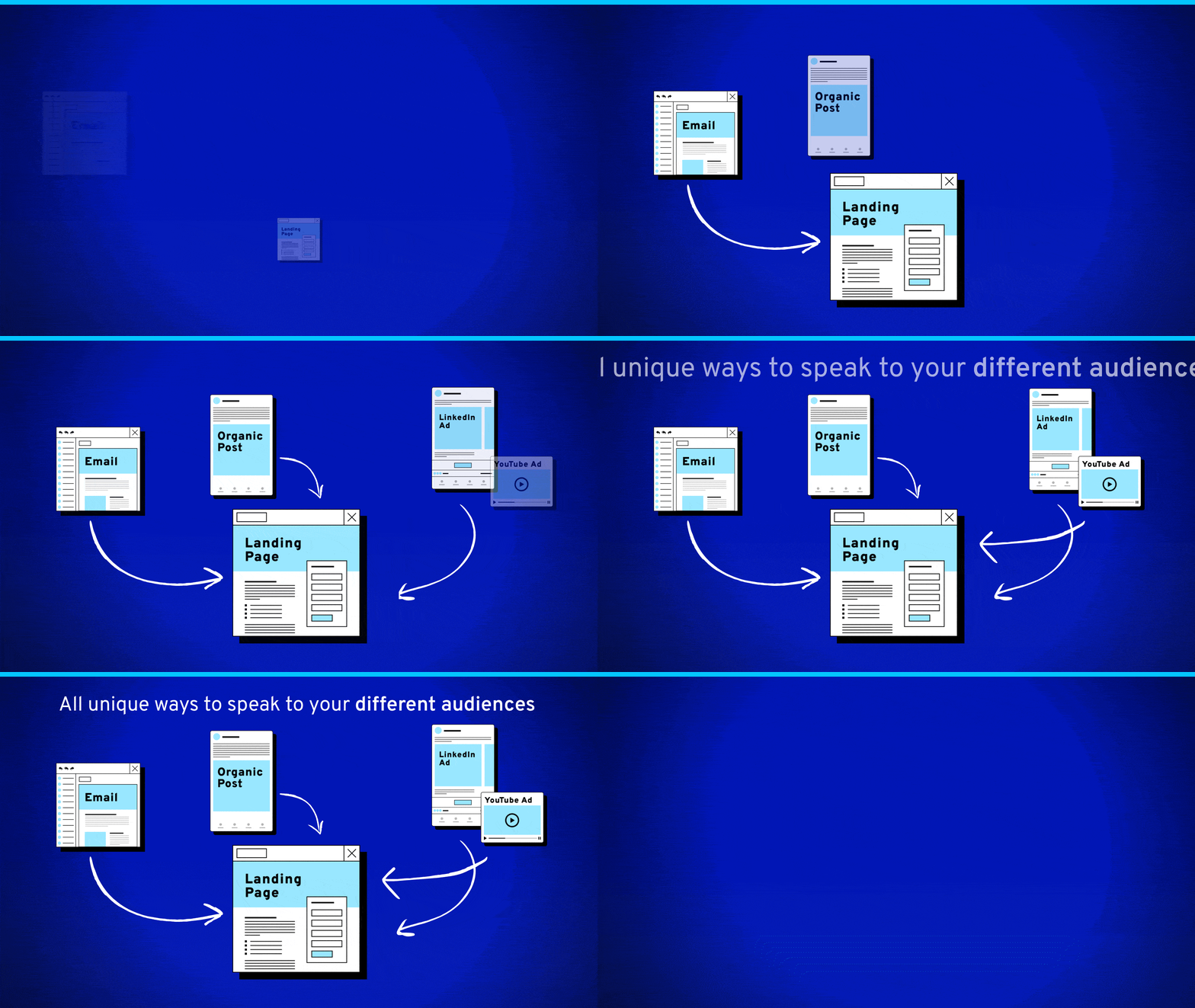
Landing pages don’t exist in isolation.
Every visitor arrives with context shaped by the channel, message, and experience that came before the click. Yet many landing pages ignore that context entirely.
That creates friction.
A buyer clicking from an email behaves differently from someone arriving through paid search. A prospect engaging with a retargeting ad has different awareness levels than someone discovering your company for the first time.
High-converting landing pages recognize this and adapt accordingly.
Imagine a buyer clicking through from a LinkedIn ad discussing operational inefficiencies. If the landing page suddenly shifts into generic product messaging, the experience feels disconnected.
Momentum breaks.
Instead, the page should continue the conversation already happening in the buyer’s mind:
To better align landing pages with buyer journeys:
Small contextual improvements often outperform major design overhauls because they reduce friction at critical decision points.
The best landing pages don’t rely on gimmicks or inflated promises.
They work because they help buyers move forward with greater clarity.
That requires more than strong copywriting. It requires understanding:
When landing pages are grounded in buyer reality, conversions become the outcome of alignment — not manipulation.
Read this article to learn more about how to rethink the buyer’s journey.
If your landing page performance is underwhelming, resist the urge to immediately change button colors or redesign layouts.
Start by asking three strategic questions:
Those answers usually reveal where conversion friction actually exists.
Because effective landing pages don’t just capture attention. They help buyers make progress.
BIBLIOGRAPHY:
Experience, World Leaders in Research-Based User. “Optimizing for Context in the Omnichannel User Experience.” Nielsen Norman Group, www.nngroup.com/articles/context-specific-cross-channel/.
by Jonathan Franchell, CEO of Ironpaper - For more tips and hacks: Need to remove a new line after h1 tags? Both web designers and SEO practitioners need to employ headline tags: H1, H2, H3 in several ways to improve web page structure and tag...

A fundamental shift is underway in how businesses discover, evaluate, and select their partners. The traditional B2B marketing model built around predictable funnels and quarterly campaigns is becoming less effective. Buyers no longer move neatly...
by Jonathan Franchell, CEO of Ironpaper - For more tips and hacks: For iOS app developers, there are some annoying parts of the development process that many developers just hate. For one, only one person can be nominated to be Team Agent on Apple's...
The Crowded Arena of the IT Marketplace Updated December 2024 The Information Technology (IT) landscape is experiencing rapid growth and intensifying competition. IT spending is projected to reach nearly 5.1 trillion U.S. dollars in 2024, a...