

Typically when Google rolls out a change in it's technology or an algorithm it does not overtly change human search behavior. This is not true with Google Instant. Search marketers have been theorizing that above all Google Instant will dramatically effect search behavior--some have gone as far as to say it would kill SEO. (We have strongly disagreed with those points.)
It is certainly too soon to have conclusive results, as to how Instant search has changed behavior. There are some clues however. eConsultancy, took a stab at analyzing search behavior, and came up with some very interesting results. This study, it should be noted, is not going to be completely accurate.
The graphic shows an increased trend toward long-term, multiple keyword searches using Google Instant. The graphic represents eConsultancy's own search data, and it does not reflect a study using more accurate data provided by Google itself. Also, it should be noted that many users cannot access the new Instant search functionality.
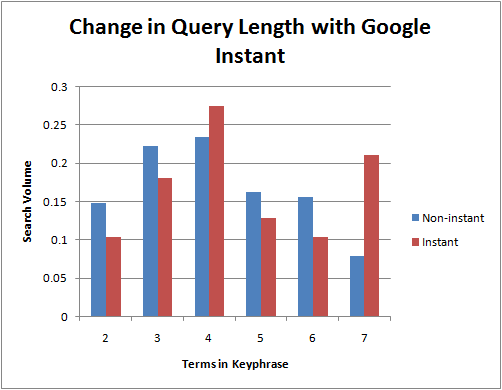
eConsultancy, Google Instant has changed the way we search, 08 October 2010
by Jonathan Franchell, CEO of Ironpaper - For more tips and hacks: Need to remove a new line after h1 tags? Both web designers and SEO practitioners need to employ headline tags: H1, H2, H3 in several ways to improve web page structure and tag...

A fundamental shift is underway in how businesses discover, evaluate, and select their partners. The traditional B2B marketing model built around predictable funnels and quarterly campaigns is becoming less effective. Buyers no longer move neatly...
by Jonathan Franchell, CEO of Ironpaper - For more tips and hacks: For iOS app developers, there are some annoying parts of the development process that many developers just hate. For one, only one person can be nominated to be Team Agent on Apple's...
The Crowded Arena of the IT Marketplace Updated December 2024 The Information Technology (IT) landscape is experiencing rapid growth and intensifying competition. IT spending is projected to reach nearly 5.1 trillion U.S. dollars in 2024, a...