


Most account-based marketing (ABM) programs don’t fail because of effort. They fail because of design.
Let’s take a moment to imagine a common scenario:
Retargeting campaigns are running. Dashboards are filling with engagement metrics. Account lists are growing. Personalization engines are humming. Yet, the pipeline for priority accounts barely moves. Win rates remain stalled. Deals fall apart in procurement. Buying groups are hesitant at best.
This is ABM theater, where many businesses are caught in an illusion. It appears sophisticated, feels modern, and generates activity, but not outcomes.
Learn more about Ironpaper ABM services
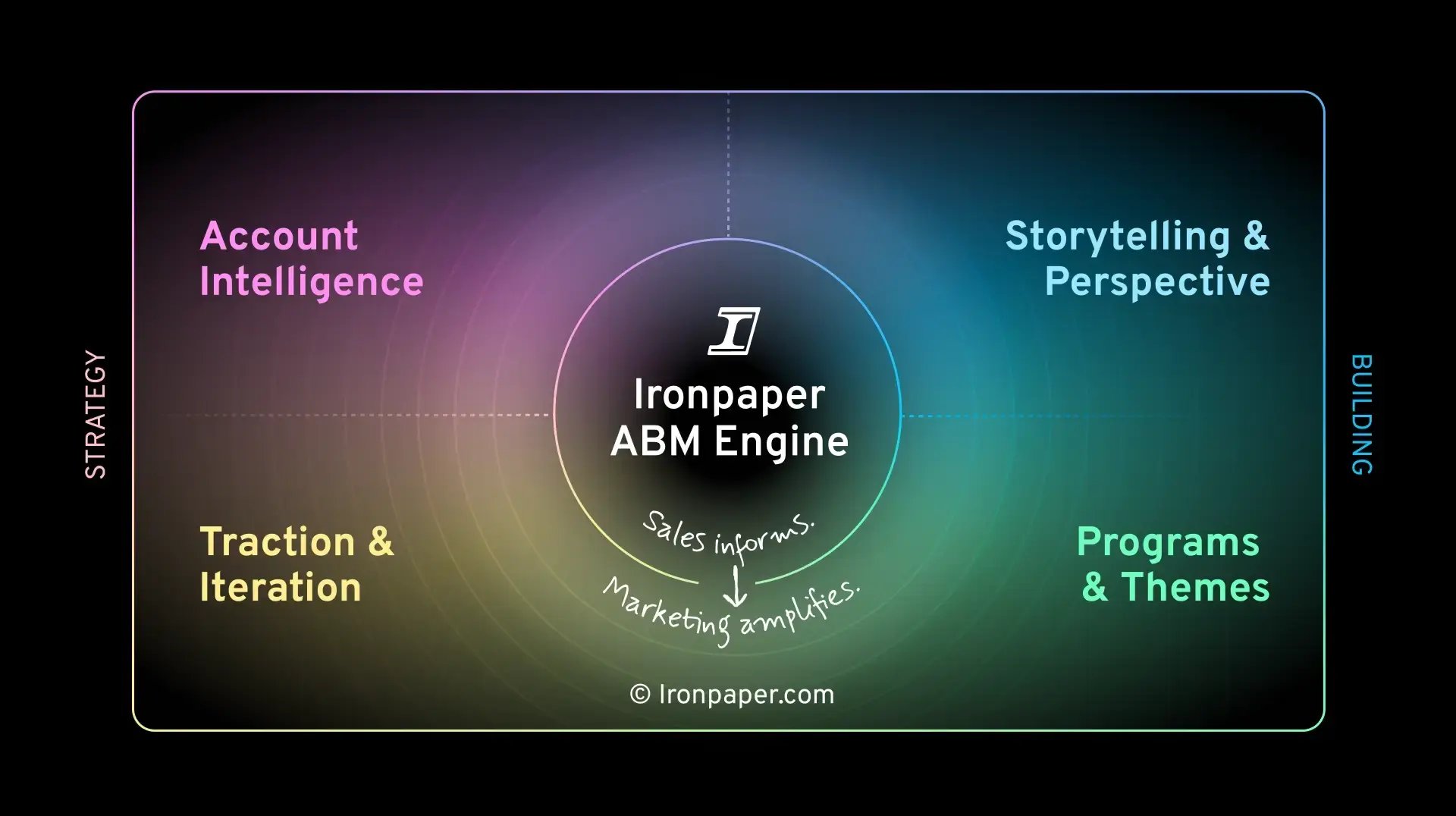
ABM is not a collection of tactics or a campaign type. It is not a list of logos inside a platform. Technology does not “unlock” ABM. Instead, ABM is an operating model designed to increase revenue from defined segments of ideal accounts, informed by strategy, research, alignment, and understanding. When companies try to “add ABM” without changing objectives, governance, and measurement, they create costs without gains.
At the risk of generalizing ABM, here are signals of common ABM theater, and here are clues on how to break free from the common traps of stalled ABM.
The first mistake is common. Many associate retargeting with ABM because it is a common tactic in many ABM playbooks. Targeted ads are a channel, while ABM is a strategy that includes various activities, reflection, guidance systems, governance models, and testing.
Retargeting is often used within ABM systems. Retargeting does not define ABM. If your ABM program consists solely of paid ads targeting specific accounts, it is not a true account-based strategy; it is merely targeted media.
Real ABM begins with segmentation discipline:
Ads amplify a strategy. They cannot substitute for one. Sure, this sounds simple, but so many companies make this mistake. It is worth reading again.
Impressions do not represent meaningful progress. Clicks do not drive a pipeline.
Engagement metrics are worth tracking in an ABM system, but too many companies mistake vanity metrics for critical growth signals. The ABM theater that traps many organizations today treats engagement as the outcome. Instead, real ABM treats engagement as a indicator of account progression, but it looks for more tangible signals of progress.
The difference is structural.
Vanity measurement looks like:
Account-based measurement looks like:
Engagement is meaningful only when tied to revenue movement and decision-making signals. Without progression logic, dashboards become decoration.
An MQL is an important indicator of B2B marketing progress, but it is not the sole sign of advancement within an ABM system. ABM focuses on account-level measurement. Companies trying to escape the ABM theater will need to move beyond isolated metrics and measure account-level progress.
When ABM is forced into reporting isolated MQLs, several problems appear:
Complex B2B purchases are made by decision-making groups, not by individuals. Even a company's CEO seeks influence and guidance from a team when the risk of a significant purchase is too high. Successful ABM does not fall victim to the myth of the “single-empowered buyer.”
Marketing must support engagement across strategic, lines-of-business, technical, financial, operational, and executive stakeholders.
Real ABM shifts the unit of value:
It tracks:
If your ABM program reports only lead volume without context, it will function like an ineffective lead-generation program. Lead volume lacking context and intelligence is also just performance without substance.
Personalization is costly and often considered the essence of ABM. An overreliance on personalization can quickly become a distraction. Strategy is foundational, and personalization is just one element of the broader relevancy approach. Many teams spend months creating bespoke microsites, customized decks, tokenized personalization, and personalized messaging based on third-party intent signals. Relying too heavily on this can blur the distinction between effort and evidence.
Effective ABM often begins small:
Going too big, too quickly, can be pure ABM theater. Instead, try this:
Deploying ABM across 300 accounts before proving the play dilutes focus and exhausts resources. ABM is about concentration, not coverage.
Most stalled deals are not lost to competitors. They are lost to indecision.
A single champion cannot carry a complex sale. Procurement wants risk mitigation. Finance wants economic clarity. Operations wants integration stability. IT wants security validation.
A “persona” mindset fails here. Decision groups must be mapped and engaged.
ABM theater focuses on isolated metrics:
Real ABM focuses on collected metrics:
When marketing and sales coordinate around the decision group and organizational needs, indecision decreases. When they don’t, deals drift because buyers face risk, complexity, and fear of failure.
A set-and-forget account list signals stagnation. Too many companies put trust into a poorly orchestrated account strategy that doesn’t adjust based on new insights and learnings. Preconceived ABM targeting is a starting point, not a destination. Similar to demand generation, account-based marketing emphasizes testing and learning as essential components of the maturity curve.
Markets evolve. Buyer needs change. Sales conversations uncover new insights. Ideal customer definitions gain depth. If your ABM list looks the same each quarter, your strategy is not adaptive, and strategy, by definition, is dynamic. It requires trade-offs, iteration, and recalibration. Mature ABM programs review quarterly:
Every account should have a clear purpose for inclusion. If that purpose cannot be explained, the account does not belong on the list.
Tools do not create strategy. Today, many organizations get hoodwinked into the allure of technology as the easy button for marketing. There is no easy button.
Platforms simply amplify whatever system exists. If governance, strategy, and alignment are unclear, the technology underneath will be merely busy work.
ABM theater often follows this sequence:
Real ABM follows a different order:
Technology is infrastructure. It is not a transformation. Technology simply enables a part of the strategy.
ABM is often mistaken for a volume play. Instead, it is a strategy of concentrating limited resources to build deep relationships with ideal customers. Volume plays can distract from this purpose.
When teams launch ABM to hundreds of accounts without:
Scaling too early creates unnecessary complexity, dilutes results, and undermines the credibility of the ABM program at a crucial time for stakeholder buy-in. Effective growth requires maturity progression.
Progression looks more like: Learn > Test > Optimize > Scale > Repeat
ABM should begin with defined pilots that set the organizational tone for testing, learning, and adaptation. These tests should be measured against account-level pipeline outcomes. Once that motion proves repeatable, scale becomes logical rather than a wild, drunken bet.
Real ABM is disciplined. It is:
ABM does not replace demand generation. For many companies, ABM can run parallel to demand generation efforts. ABM can actually help refine and clarify demand generation while benefiting from it. Good ABM moves away from volume plays to value and strategy adaptation. From anonymous traffic to defined accounts. From isolated leads to coordinated decision groups.
ABM is not just a tactic added to marketing; it is a fundamental shift in how marketing and sales collaborate to generate revenue from the most important accounts.
If your ABM program increases activity but does not change win rates, deal velocity, or revenue concentration within your ideal customer profile, the juice is not worth the squeeze. Don’t get lost in the theater of ABM. Instead, use ABM principles to improve strategy and enable a holistic marketing-to-sales system to drive real growth.
by Jonathan Franchell, CEO of Ironpaper - For more tips and hacks: Need to remove a new line after h1 tags? Both web designers and SEO practitioners need to employ headline tags: H1, H2, H3 in several ways to improve web page structure and tag...

A fundamental shift is underway in how businesses discover, evaluate, and select their partners. The traditional B2B marketing model built around predictable funnels and quarterly campaigns is becoming less effective. Buyers no longer move neatly...
by Jonathan Franchell, CEO of Ironpaper - For more tips and hacks: For iOS app developers, there are some annoying parts of the development process that many developers just hate. For one, only one person can be nominated to be Team Agent on Apple's...
The Crowded Arena of the IT Marketplace Updated December 2024 The Information Technology (IT) landscape is experiencing rapid growth and intensifying competition. IT spending is projected to reach nearly 5.1 trillion U.S. dollars in 2024, a...